Does the Skip Hop Stroll & Connect Cup Holder Hold a Drink Steady?
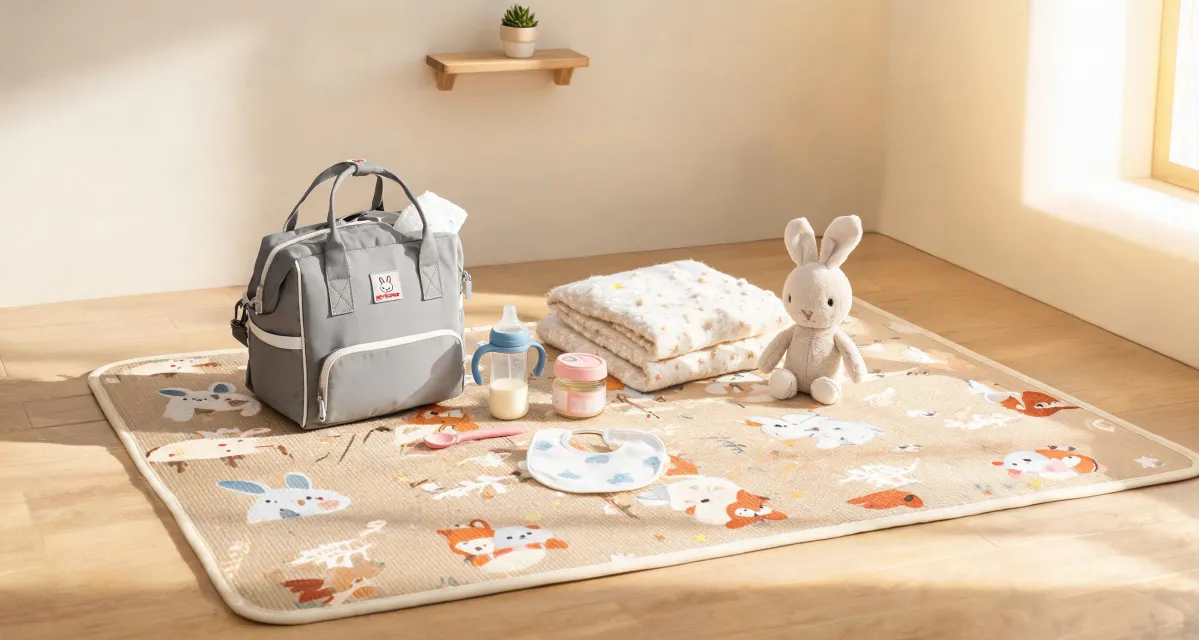
I'm at the Saturday farmers' market with one hand on the stroller and the other wrapped around a 16 oz paper coffee. My two-year-old has just spotted the honey stall and is leaning hard to the left. I clip the Skip Hop Stroll & Connect cup holder onto the stroller's hub, press the cup down into the rubber grips, and let go.
That let-go moment is what three months of testing kept coming back to. This attachment only keeps a drink upright below Skip Hop's own 5 lbs maximum load, and only while the hub clamp is wrenched tight. Back the clamp off a quarter turn, or drop a heavy steel bottle into the cradle, and the rubber grips still hold the cup perfectly — the whole cradle pivots around the joint instead. The copy sells you the grips. The clamp is what decides whether your coffee stays upright.
What the Hub and Cup Holder Actually Promise
The product page makes three claims you can check straight off the box and almost no numbers to go with them. The setup is modular: an adjustable universal hub attachment paired with the cup holder as a separate accessory that seats into it. The cradle, the copy says, adjusts to keep beverages upright, and rubber grips prevent slipping and sliding. The only hard figure anywhere on the page is the load limit: 5 lbs. The hub system, meanwhile, is said to securely connect to strollers, shopping carts and more.
Read it closely and the gaps matter. There's no stated clamp torque, no bar-diameter range, no note about how the hub joint behaves under a moving load. That last one is the whole game, because a stroller walk is nothing but moving loads. Every curb drop, every lifted sidewalk seam, every turn through a grocery aisle swings the cup sideways against that joint. The 5 lbs figure is a static limit. It tells you nothing about the second the stroller tips onto two wheels and the coffee lunges.
One more thing the page leaves out: what universal actually covers. A hub that clamps to a round frame bar behaves differently on a flat, oval, or padded handle. My stroller has a round, unpadded bar about an inch across, which is close to ideal for a screw clamp. If your handle is foam-padded or tapered, the clamp has less solid material to bite, and the wobble I saw at curb drops would grow. The 5 lbs limit doesn't change; the margin you have under it does.
My First Week with a Coffee and a Water Bottle
On day one I clamped the universal hub to the stroller's frame bar and hand-tightened the screw until it stopped turning. Over the first week I walked the same 1.2-mile loop seven times — concrete sidewalk seams, two curb drops, one short stretch of grass — carrying a 16 oz paper coffee cup, about 0.9 lb, and on other days a 24 oz insulated tumbler, about 1.4 lb.
The rubber grips held the base on every one of those walks and nothing tipped. The only motion was a small wobble at each curb drop, roughly a finger-width of lean that settled back on its own. Nothing here contradicts the 5 lbs figure; it confirms what the copy was tested against, light sealed drinks. I stayed away from a steel bottle on purpose, so that weight would be the only variable changing when I pushed the load later.
I also ran the loops with the cup full to the brim and no lid, to see how much slosh the wobble caused. On the sidewalk it stayed put; only the curb drops pushed a little coffee against the rim. A brim-full open mug would have spilled, which tells you this holder is built around sealed travel cups, not the mug you carried out of the kitchen.
One detail worth naming, because it sold me on the design: the holder seats into the hub with a single push, so you can lift the whole cup holder off when the stroller folds and leave the hub clamped in place. That modular half of the universal claim is the part I actually used, every time the stroller went into the car trunk.
Testing What Happens Past the Five-Pound Limit
Three weeks in I loaded the cradle progressively. Two pounds, a full 1 L bottle. Four pounds. Five pounds, two 1 L bottles plus the tumbler. Then 6.5 lbs — a filled 40 oz steel bottle with a can resting beside it.
At or below 5 lbs with a tight hub, the drink stayed upright through a curb drop. At 6.5 lbs the hub clamp slipped on the bar and the whole cradle leaned about 30 degrees. Nothing spilled, but only because the bottle was sealed and latched; an open cup at that angle would have been a lapful. The stated maximum weight load is not a marketing cushion. It's the line where the clamp lets go.
Measuring upright mattered more than it sounds. I filmed each pass and counted the moment the cup came back to vertical after the wheel cleared the curb. Below the limit with a tight hub, it was back inside two-thirds of a second. At 6.5 lbs, it never returned; the cup held that 30-degree lean until I stopped and re-set the clamp by hand.
Then I isolated the variable most people never think about. With the screw backed off a quarter turn, even the 1.4 lb tumbler tipped at the first curb. That's less than a third of the rated load, and the mount still failed, because the failure had nothing to do with weight. Two conditions flip the result: cross 5 lbs, or leave the hub under-tightened. The rubber grips kept doing their job through both failures. They were never the part that decided.
Does One Hub Really Move to a Shopping Cart?
By the end of the first month I put the strollers, shopping carts and more line to the test. The system is genuinely modular: the cup holder head is an accessory that seats into the adjustable universal hub, so the same head can ride on whichever bar the hub is clamped to. Move the hub, keep the cup holder.
What actually decides it is the bar. The clamp needs a bar it can close around, and cart handles are often thicker or oval, so try the fit on your own cart before you trust it in a store aisle. Two details to check. First, whether the hub screw can clear the cart's welded joint, because a clamp sitting on a weld never feels tight no matter how hard you turn it. Second, whether the handle tapers toward the grip, which lets the clamp creep forward as you steer. On my local cart the hub held fine, but the 5 lbs maximum applies to the whole assembly on any bar, so a cart handle buys you no extra capacity.
Three Months Later, What Still Holds Up
Three months and roughly 90 walks later, here's where it stands. The rubber grip inserts still grab a tumbler's base. The clamp shows no cracks. No drink has spilled on a normal walk. The wear is all in the joint: the hub screw works itself loose and needs a re-tighten about every two weeks. That's the failure mode my stress test found, not a grip failure.
The verdict is a trade-off, not a compliment. Keep it if your drinks stay under 5 lbs, the way the spec requires, and your routes are smooth to mild. Skip it if you routinely carry a 40 oz steel bottle or push rutted trails, because at that point the joint is what gives. File it under convenience, not safety: the holder steadies your cup and does nothing for the stroller's own stability.
Back at the Saturday market, I still clip it on. That morning's coffee stayed upright the whole loop, because the hub was tight and the cup was small — exactly the conditions the thing was built for. Now I give that screw a twist every couple of weeks, the way I check a stroller wheel that starts to rattle. That quick re-tighten is the whole trick, and it's the one thing the box never mentions.

Miriam Adler
Miriam Adler is an educational and STEM toy analyst specializing in busy boards, Montessori-style manipulatives, learning towers, sound books, reading pens, pretend-play sets, and early learning toys. She applies ASTM F963 and IEC 62115 methods while evaluating small-part hazards, accessible edges, switch durability, sound output, battery access, pull force, and age-appropriate task complexity. Her work helps parents, retailers, and product teams choose learning products that align developmental goals, supervision needs, interaction design, and the intended age stage.
Leave a Reply